
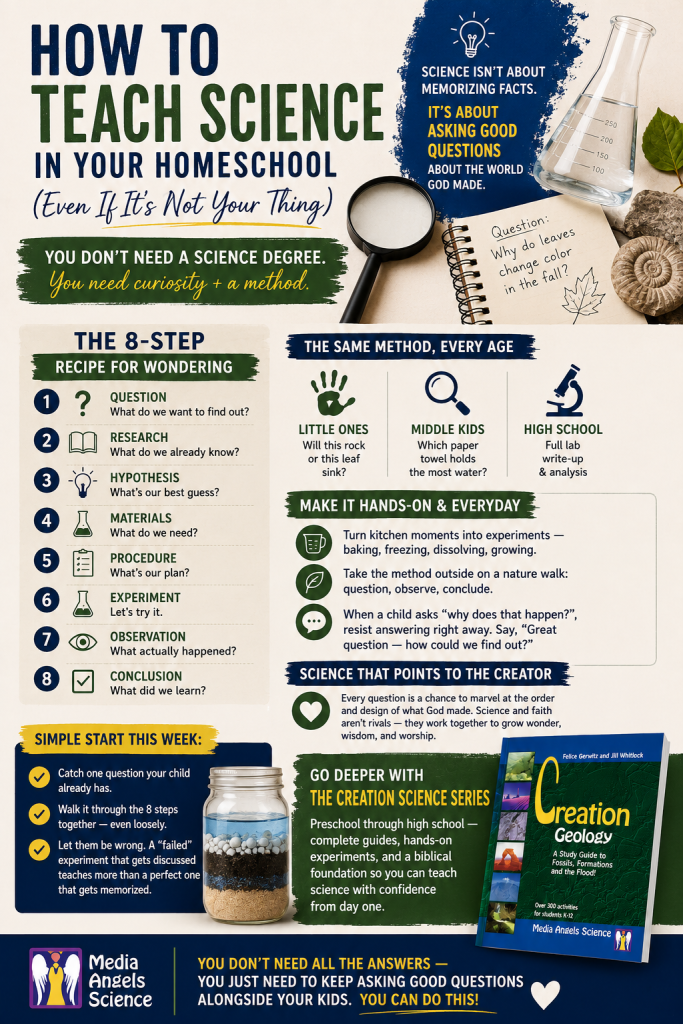
How to Teach Science in Your Homeschool (Even If It’s Not Your Thing)
Let’s start where a lot of homeschool moms secretly live: “I’m not a science person. How am I supposed to teach this?”
Take heart — you don’t have to be a scientist to teach science. Science isn’t a mountain of facts you have to have memorized. It’s a way of asking questions about the world God made — and you already do that every time you wonder why the bread rose or where the puddle went. Once you see science as curiosity with a little structure, teaching it stops feeling like a subject you have to survive.
Science is a method, not a memory test
Here’s the reframe that changes everything: the heart of science isn’t information, it’s inquiry. And inquiry has a simple, repeatable shape — the scientific method. Teach your children that shape, and they can investigate almost anything, at any age.
Think of it as a recipe for wondering:
- Question — what do we want to find out?
- Research — what do we already know about it?
- Hypothesis — what’s our best guess?
- Materials — what do we need?
- Procedure — what’s our plan?
- Experiment — let’s try it.
- Observation — what actually happened?
- Conclusion — what did we learn?
That’s it. That’s “real science.” A four-year-old and a high schooler can both walk that path — the difference is just the size of the question.
The same method, every age
Don’t let the word “experiment” intimidate you. For your littlest ones, it might be “Will this rock or this leaf sink?” For your middle kids, “Which paper towel holds the most water?” For your teens, a full lab writeup. Same eight steps, growing with them. You’re not teaching a hundred different things — you’re teaching one good habit of thinking, over and over.
Make it hands-on and everyday
Science sticks when kids do it, not just read it:
- Turn kitchen moments into experiments — baking, freezing, dissolving, growing.
- Take the method outside on a nature walk: question, observe, conclude.
- When a child asks “why does that happen?”, resist answering right away. Say, “Great question — how could we find out?”
Curiosity is the fuel. Your job isn’t to have every answer; it’s to keep the wondering going.
Science that points to the Creator
For a Christian family, there’s a deeper layer. Every question your children investigate is a chance to marvel at the order and design of what God made. Science and faith aren’t rivals at your kitchen table — taught together, science becomes one more way your children come to know and worship the God who made it all. That’s the difference between teaching facts and building awe.
A simple way to start this week
Don’t wait until you feel qualified:
- Catch one question your child already has this week.
- Walk it through the eight steps together — even loosely.
- Let them be wrong. A “failed” experiment that gets discussed teaches more than a perfect one that gets memorized.
Where to go next
If you’d love the structure handed to you, our Creation Science series was built for the parent who wasn’t sure they could teach science — preschool through high school, with the experiments, guides, and biblical foundation already laid out, so you can teach with confidence from day one.
And to readFelice’s own take on teaching science without a science background, read here.
You are more equipped than you think. You don’t need all the answers — you just need to keep asking good questions alongside your kids. That’s science, and you can absolutely do it.
📚 Part of our complete guide: Creation Science for Homeschoolers — the why, the how, the subjects, and the curriculum to teach it all at home, in one place.